
If you are an aggressive team, the “Chip & Chase” is your worst enemy.
We’ve all been there: You want to pinch your Defensemen to keep the pressure on. But the moment you pinch, the other team chips the puck past your D, wins the footrace, and suddenly the game turns into a track meet.
It wears down your Defensemen and forces you to play “reactionary” hockey.
Most coaches think the answer is to retreat into a passive Neutral Zone Trap. They are wrong.
You don’t need to stop being aggressive. You just need to change where you apply the pressure. In this post, I’m breaking down the “Aggressive” 1-2-2 Forecheck and the simple adjustment that kills the chip & chase forever.
The Mistake: The “Red Line” Wait
In a standard 1-2-2, you typically have F1 flush the puck while F2 and F3 wait back at the Red Line.
The problem? That gap is too big.
If F2 is waiting at the Red Line, the opposing defenseman has too much time to skate, look up, and execute a chip play. By the time F2 engages, the puck is already past them.
The Solution: The “Hashmark Seal”
The key to the Aggressive 1-2-2 is moving F2’s starting position down to the Hashmarks.
We call F2 “The Seal.”
When F1 flushes the puck carrier, F2 does not wait. They slam down immediately to the hashmarks on the strong side.
- The Goal: Take away the boards.
- The Result: The opposing defenseman looks up to chip the puck, but F2 is already in their face. They can’t skate, they can’t chip, and they usually panic and ice the puck.
The “Foosball” Concept
For this to work, your forwards have to move like they are attached to a rod on a foosball table.
If F1 slides to the left to flush, F2 must slide across to seal. They move as a connected unit. If there is a disconnect—if F1 goes and F2 watches; or if F2 and F3 “foos” at different speeds—the gap opens up and you get burned.
Coaching Tip: Tell your players, “If F1 goes, F2 goes. You are on a string.”
Roles & Responsibilities
- F1 (The Flusher): Steers the play from the inside-out. Do not skate in a straight line; take a banana curve to force them up the wall.
- F2 (The Seal): The most critical role. Must get to the Hashmarks to kill the wall play.
- F3 (The Hedge): The safety valve. Patrols the middle of the ice to intercept passes or cover for a reverse.
Bonus: The “Animal” Analogy for Youth Teams
If you are coaching younger players (U10/U12) who struggle with numbers like F1/F2, try using these cues:
- F1 is the Cheetah: Fast, hunting the puck, pressuring up ice.
- F2 is the Lion: The King of the Jungle. They own the wall and seal off the territory.
- F3 is the Eagle: Soaring in the middle, reading the play, ready to swoop down if needed.
Get the Blueprint
Want to install this system at your next practice? I’ve put together a 2-Page PDF Blueprint that diagrams the exact positioning and movement.
It includes the diagrams for the Forecheck, plus the “Foosball” visual to show your players.
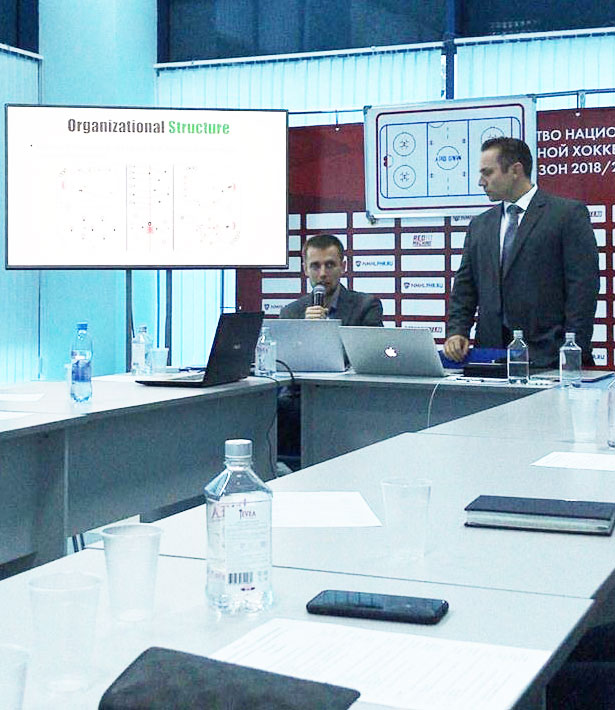
Jeremy Weiss (with his translator) presenting at a hockey coaching symposium for the Russian Federation in Moscow—2018.
Who is Jeremy Weiss?
Hockey coach and international consultant, Jeremy Weiss, has worked with thousands of coaches worldwide since 2008 to help produce championship teams at every age and skill level.
He is known internationally through the work he has done online. In 2008 he invented “digital chalktalks” which combined screen sharing with drill diagramming software, to produce a training experience nobody had ever seen before. His YouTube following quickly grew to over 19,000 subscribers, and he has produced over 130 training videos.
Jeremy runs a development blog for coaches, which has over 280 posts. He is the author of 10 hockey books for coaches, and is the editor of Hockey Development Magazine.
He was trained in the Eastern European style as a pre-teen, by his Czechoslovakian skills coach, and competed internationally as a “Wexford Raider” among the top youth hockey programs in the world including Russia, Czechoslovakia, Finland, and top teams in his home province Ontario, Canada.
He majored in Exercise Sciences at Brigham Young University, and subsequently worked as a Personal Trainer, where he continued to study and develop ideal training methods for hockey.
He has incorporated the very best pieces from the various training styles he has been involved in, and has built a world-class off-ice strength and conditioning program that fits the specific needs of hockey players.

